
February 03, 2026
Top 10 Emerging Tech Trends Every IT Student in Nepal Should Know in 2026

Nepal’s Information Technology Industry is evolving faster than ever before. Businesses in Kathmandu and beyond now compete not just locally, but on the global stage. Specialised IT positions, such as cloud architects, AI & machine learning engineers, and cybersecurity experts, earn significantly higher salaries than general IT roles. Fresh graduates in these specialised fields can earn NPR 25,000- NPR 50, 000 or more per month -a substantial increase from just a few years ago, when entry-level positions typically paid NPR 15,000 to NPR 20,000. For IT students, keeping up with emerging technologies is no longer optional. It's essential for career success and competitive salaries.
Why IT Students in Nepal Must Stay Updated with Tech Trends
The Changing Landscape of IT Jobs in Nepal
Just a few years ago, a job in IT would be easily available just by knowing how to use Microsoft Office or other basic software in Nepal. Before the companies were ready to recruit pass outs with a basic knowledge of computers. By 2026,employers want specific skills like React development, AWS cloud expertise, or machine learning knowledge
For example, banks and financial institutions are now explicitly looking for candidates with expertise in artificial intelligence and machine learning to automate processes and enhance customer service.
Salary Differences of IT Roles in Nepal
Fresh graduates are getting paid about NPR 25,000 to NPR 50,000 per month. But salaries are quite different for specialist skills. Cloud engineers usually make between NPR 60,000 and NPR 120,000 per month. Cybersecurity experts make approximately 60,000 NPR to 1,20,000 NPR per month or more. These numbers indicate that with suitable experience, experts in AI, cloud, and cybersecurity can expect to make even more money. These are all indications that specialisation pays when it comes to earning power.
Remote Work Revolution
Remote work is one of the most transformative trends in the IT industry for students. With remote roles, students can work for companies overseas while living in Nepal. These remote opportunities often pay in foreign currency and can be much more lucrative than local roles. This shift means IT students need to develop skills that companies around the world are willing to pay for.
How Tech Trends Shape IT Courses in Nepal
The Curriculum Problem
Conventional IT courses in Nepal are typically theoretical and based on outdated concepts. Many curricula are slow to change. So, graduates might be going into the job market not knowing some of the latest technologies that employers are seeking.
What Progressive Colleges Are Doing
Progressive colleges in Kathmandu and elsewhere are updating their curricula to match industry demands. They're integrating current frameworks like React instead of outdated technologies like jQuery, partnering with tech companies for real-world projects, and inviting industry experts as guest lecturers. These institutions focus on hands-on learning with industry standard tools and practical assignments. Many maintain affiliations with international universities, ensuring students learn globally.
Your takeaway: Don’t just fall back on your college syllabus. Consider this list as a roadmap to take you through some key technologies. Then, fill up on online classes, workshops, hands-on projects, and real-world exposure.
Trends
Artificial Intelligence and Machine Learning Revolution
Artificial intelligence and machine learning are no longer buzzwords but key components of how modern technology works. Companies in all industries leverage AI for data analysis, automation, and more informed decision making. Nepal has also introduced a national AI policy in late 2025 to encourage a safe and ethical usage of AI in different sectors, including education and agriculture, among them. It illustrates how crucial AI will be to the country’s future.
Key Technologies to learn
The important technologies for AI and machine learning are:
- Python programming
- Machine learning libraries such as TensorFlow and PyTorch
- Data analytics tools
- Neural networks
- Natural language processing
These skills are very vital for students aspiring to get into AI related roles.
AI Applications in Nepal’s Job Market
AI has many applications in Nepal. In the banking sector, machine learning models help with credit scoring and fraud detection. Telecom companies use machine learning to analyse network performance and customer usage patterns. Startups use AI to build smarter mobile apps and intelligent systems. Employers today want candidates who can not only understand AI concepts but also use them to build solutions.
Skills Employers Want
Employers look for Python coding proficiency, a strong understanding of data handling, and the ability to build models that solve real problems. Project experience and knowledge of industry tools also matter.
How BSc Computer Science Nepal Programmes Are Adapting to AI
Many BSc Computer Science and information technology programmes in Nepal have started offering courses in AI and machine learning. However, not all these courses include practical, project-based learning. This gap means that even after completing coursework, students may not have hands-on experience using AI tools to build solutions.
Progressive institutions are now integrating practical AI labs, real-world datasets, and projects into their syllabi. This helps students build the skills needed by employers.
Best IT Programmes in Kathmandu Teaching AI and ML
There are many types of IT courses in Kathmandu, which teach artificial intelligence (AI) and machine learning (ML), each of which has its own strengths and weaknesses. University courses tend to be very theoretical students gain a deep understanding of the fundamental concepts, but hands-on AI lab sessions may be limited.
UK-recognized colleges offer industry-relevant curriculum and practical knowledge; however, students are expected to do a lot of self-study. Since online courses are very practical and project based, they are excellent for learning skills, but they usually aren't as formally accredited.
Cybersecurity Nepal’s Most in Demand IT Skill
Cybersecurity has emerged as one of the fastest-growing tech fields in Nepal. As more businesses go digital, the need to defend systems against attacks continues to grow. Banks, government departments, and technology companies are investing heavily in data security to protect customer trust.
Rising Cyber Threats in Nepali Organisations
In recent times, social scams, phishing attempts, and other security breaches have been on the rise. These threats also target financial institutions, e-commerce, and, yes, even education. Security risk assessment, ethical hacking, and incident response now top the wish lists of recruiters at organisations that care.
Why This Matters Now
With digital platforms catering to millions of users, a breach in cybersecurity can be disastrous. Cybersecurity positions are now viewed as more essential than optional, though that designation remains aspirational.
What Companies Are Looking For in 2026
Companies need people who can identify system vulnerabilities, defend their networks, and respond quickly to incidents. Entry-level jobs frequently focus on watching for security notifications and conducting rudimentary analyses. With experience, they are able to specialize as a penetration tester or incident response lead, amongst other things.
You should have a good understanding of network security concepts, risk assessment, white box hacking, and security tools.
UK IT Courses in Nepal with Cyber Security Focus
The UK-based IT degree, on the other hand, tends to embed more hands-on related cybersecurity modules. These programmes also enable students to prepare for international certifications. When you're looking for college, find out about the lab facilities, security-related classes, and internships that do real-world security work.
Students can begin their cybersecurity path with free products, including online security labs, community challenges, and introductory ethical hacking exercises.

Cybersecurity Career Ladder
Cloud Computing and DevOps
Cloud computing is a lucrative and rapidly emerging field in the tech industry of Nepal, as companies are migrating their systems to cloud-based platforms like AWS and Microsoft Azure to enhance scalability and lower infrastructure costs. Organizations don’t keep physical servers anymore; they host applications online, which increases reliability and makes it easier to manage workloads for many users. This has led to a rising demand for cloud engineers and DevOps professionals who can architect, provision, and operate applications on leading platforms, including Amazon Web Services, Microsoft Azure, and Google Cloud Platform.
In parallel with this growth of cloud computing, DevOps has emerged as an important cultural change in IT that unites development and operations teams through automation, continuous delivery, and collaboration to allow organizations to release software faster and with fewer errors.
Cloud Computing in IT Course Nepal Curriculum
Nowadays, many IT institutes in Nepal teach cloud computing, however the extent of training is not similar. There is strong local demand for cloud professionals, but there are also numerous remote positions available. Cloud experts holding certifications can also have a better salary
Typical salary ranges for cloud and DevOps jobs by experience level. Entry-level roles generally pay about NPR 25,000 and above. Mid-level positions can go even higher, with international offers paying even higher. Certificates like those of AWS Solutions Architect and Azure Administrator could potentially lead to enhanced roles.
But not every university curriculum includes practical cloud labs or certification assistance. Students should be on the lookout for courses that have hands-on experience and real cloud projects.
AWS and Azure Training in Kathmandu IT Colleges
When it comes to college cloud training, students should seek courses that provide hands-on cloud labs, projects on real AWS and Azure tools, and training for popular cloud certifications. Students can also develop cloud skills on their own by leveraging the free tiers of both AWS and Azure and by taking part in online guided labs and community challenges, in addition to formal education.
Data Science and Big Data Analytics
Data science serves at the intersection of business and technology, where the goal is to use data to inform decisions and business strategies. Banks, telecom, and e-commerce platforms are now employing data analytics in Nepal as a means to serve their customers and enhance their business.
With the growing importance of data-driven decision-making, data science is booming in the Nepalese industry as well. This has fuelled a strong demand for individuals who can analyse data, discover patterns, and translate insights into strategic actions.
Data science is crucial now more than ever since organisations must handle a massive amount of data that needs to be processed and analysed. These considerations allow companies to forecast customer behaviour, improve goods and services, and minimize costs.
There are actually separate roles within the data science realm. A data scientist is a model builder who uses predictive models and machine learning. A data analyst is more focused on analysing data sets and visualizing output, and a data engineer is responsible for the architecture of data and the maintenance of data pipelines. Knowing these distinctions will help students determine the path that best fits their interests and abilities. 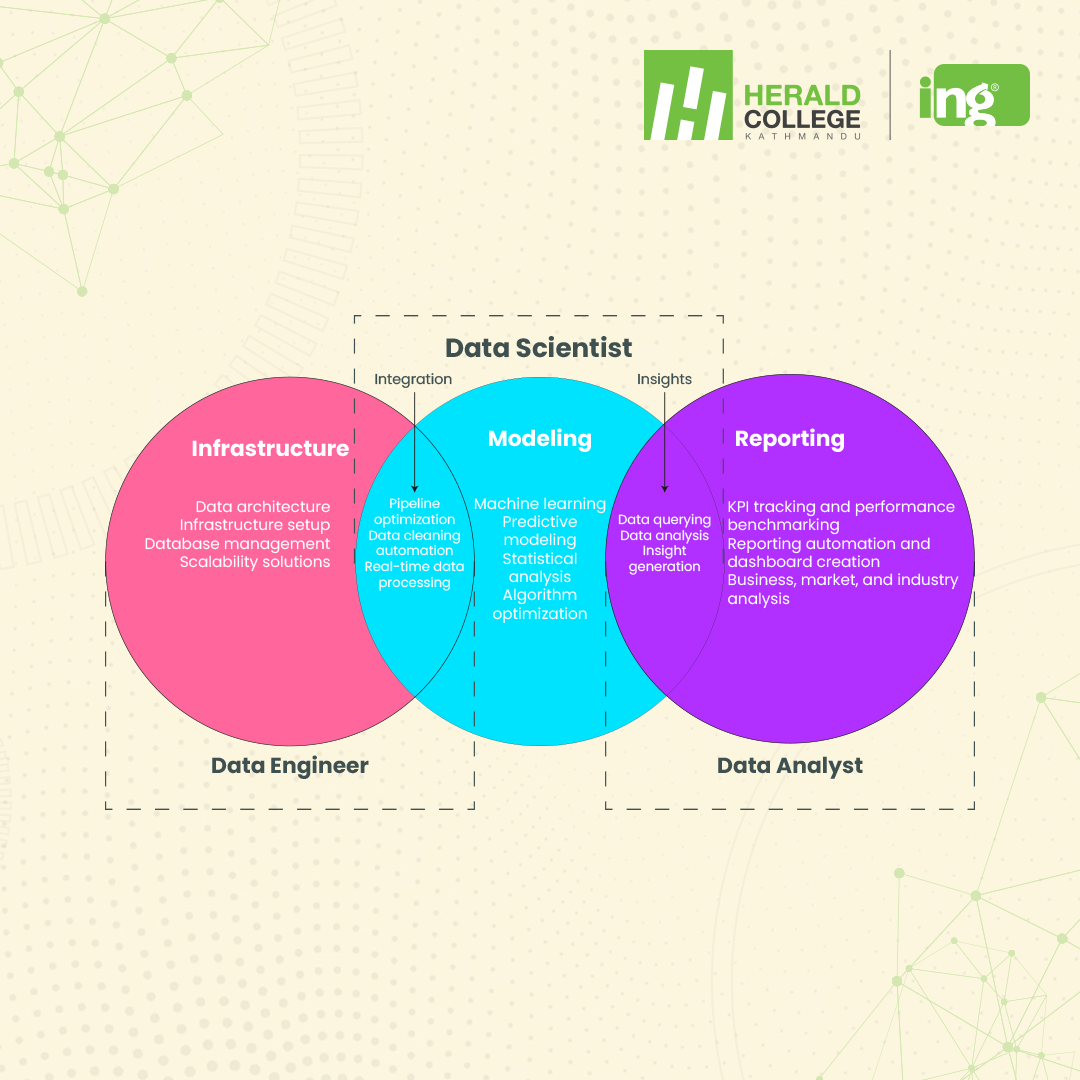
Data science, Data engineer and Data Analyst interlinked role
Data Science Career Opportunities in Nepal
Companies in banking, telecom, and online services hire data professionals. There are increasing opportunities not just locally but also with international companies that allow remote work.
Data Analytics in Nepal: Which Colleges Actually Teach It
There is a difference in how well data analytics is taught among the different colleges. A good education in data science involves hands-on work with real data, tools such as Python, R, or SQL, and visualization tools such as Tableau or Power BI. Programmes that emphasise projects and real industry tools are what students should look for.
Tools Every Data Science Student Should Master
Data science tools include:
- Programming languages such as Python
- Visualisation tools such as Tableau and Power BI
- Big data tools such as Hadoop and Spark
Students can learn these tools through online courses, college labs and open competitions such as data hackathons. Project ideas using Nepal data include analysing tourism trends or forecasting energy consumption.
Internet of Things and Smart Technologies
The IoT connects physical objects to the internet so they can acquire and share information. The potential of IoT is high in the context of Nepalese agriculture, health, and energy management were linked systems could stream efficiency and decision-making.
On the other hand, applications of IoT in Nepali situations are like the use of sensors to monitor crops by farmers, remote patient monitoring for better healthcare, and smart energy solutions that cut down on wastage and make more efficient use of resources. These solutions prove invaluable when you have to tackle local problems with constrained resources.
BSc Computer Science degrees in Nepal do cover IOT but the labs and practical projects offered by these colleges vary in quality. A good IoT curriculum generally includes working with sensors & microcontroller programming, cloud connectivity for processing & analyzing the collected data.
Smart city projects in Kathmandu employ networked devices and data-driven systems to manage traffic, waste, and public services. These initiatives are opening up new IT work avenues in disciplines including data analytics, system management, and IoT solution design.
Students interested in IoT can start gaining practical skills with inexpensive hardware such as Arduino and Raspberry Pi to create simple IoT solutions and prototypes.
Blockchain and Cryptocurrency Technology
Blockchain is a method of recording information in a way that makes it difficult or impossible to change, hack, or cheat the system. Although it is well known that its primary role is to provide a place for cryptocurrencies, there are countless other uses of blockchain such as supply chain management, digital identity management, smart contracts, online voting systems.
In addition to Bitcoin and other cryptocurrencies, blockchain enables organizations to track products, confirm identities and execute contracts without the need for intermediaries. The result is that transparency is enhanced, costs are reduced, and trust between parties is boosted, which means blockchain is useful in a range of industries.
Cryptocurrency trading is still banned in Nepal in 2026; nonetheless, global interest on blockchain technologies is on the rise. Hence, knowledge of blockchain theory and application development can open up new work prospects for you, such as engagements from overseas and in futuristic technology sectors, even if cryptocurrency use is prohibited.
Are IT Courses in Nepal Teaching Blockchain?
Most IT curricula cover fundamental blockchain concepts, but there is still plenty of space for in-depth, project-based blockchain education. Students who gain hands-on experience with smart contract programming and distributed systems also have better chances to work in global and remote job markets.
Career in Blockchain for Nepali Students
Linked to this are roles such as the blockchain developer, smart contract programmer, and distributed systems engineer. Students interested in pursuing these careers should study programming languages such as Solidity and will find it helpful to learn JavaScript frameworks that are used in blockchain application development. Students can also contribute to open-source projects, such as building decentralized applications, and thereby build impressive portfolios and demonstrate real-world skills to potential employers.
Mobile First Development and Progressive Web Apps
Mobile development is the act or process by which application software is developed for handheld mobile devices, such as personal digital assistants, enterprise digital assistants, or mobile phones. Mobile development is increasingly popular in Nepal as mobile penetration is very high. Leading Nepali apps like eSewa and Pathao show how mobile technology helps millions of users every day to pay, travel, and access other essentials of life. The number of mobile application developers with skills in frameworks such as Flutter and React Native is on the rise. Progressive web apps that run as a native app in a web browser are also gaining good momentum, which means more windows of opportunity for developers in the mobile technology space in Nepal.
BIT vs BSc CSIT: Which Is Better for Mobile App Development
Both the BIT and BSc CSIT curricula offer strong IT knowledge, based on programming, databases, networking, software development, etc. The distinction between the two usually lies in the ratio of practical to theoretical knowledge. BIT Courses are more practical-based so that students will have greater opportunities to work on real-life problems. However, BSc CSIT programmes are usually more theoretical and aim for more thorough knowledge of algorithms, computing principles, and mathematical basis.
Always, the quality of projects and the real-life application exposure are the values that students should really expect from the course, regardless of the program. Doing internships, practical labs, or working on independent projects allows students to convert theoretical knowledge into practical skills, which is essential for crafting a successful career in IT. In the end, the difference between a BIT and BSc CSIT lies in what type of learner and what type of career the student wants to pursue from the study, be it more hands-on or more theory-centric.
Where to Learn Flutter and React Native in Kathmandu
Students can learn mobile frameworks through college programmes that include real app projects. There are also many online courses and local bootcamps that focus specifically on mobile app development. Freelancing platforms provide opportunities to build real apps for clients.
Low Code/No Code Development Platforms
Low-code and no-code platforms enable users to develop applications without having to write code or having significant programming expertise, which is what makes them great options for prototyping rapidly, automate workflows and fast innovate on ideas. Platforms such as Webflow and Zapier empower students to build real applications quickly and to work hands-on with projects from the real world.
While they facilitate speedier development, these platforms are not a substitute for knowing how to program. Students should learn how to code and think about software design properly first, then use low-code/no-code platforms to speed up development, test concepts and build real software. This versatility makes students equally prepared for traditional software roles and modern, high-tempo development teams.
Edge Computing and 5G Technology
The telecom operators in Nepal are currently launching 5G services that are capable of delivering higher speeds and lower latency than the previous Telecommunications technology. Such infrastructure supports the adoption of real-time analytics, connected devices, and more intelligent IoT ecosystems, providing new avenues for IT professionals.
Edge computing, which processes data nearer to the location where it's generated, complements 5G, as the technology is expected to be widely used in applications with high-speed response requirements, including smart city and industrial Internet of Things (IoT). Learning network basics, and real time, and cloud, will also be useful for students to work with edge computing technologies.
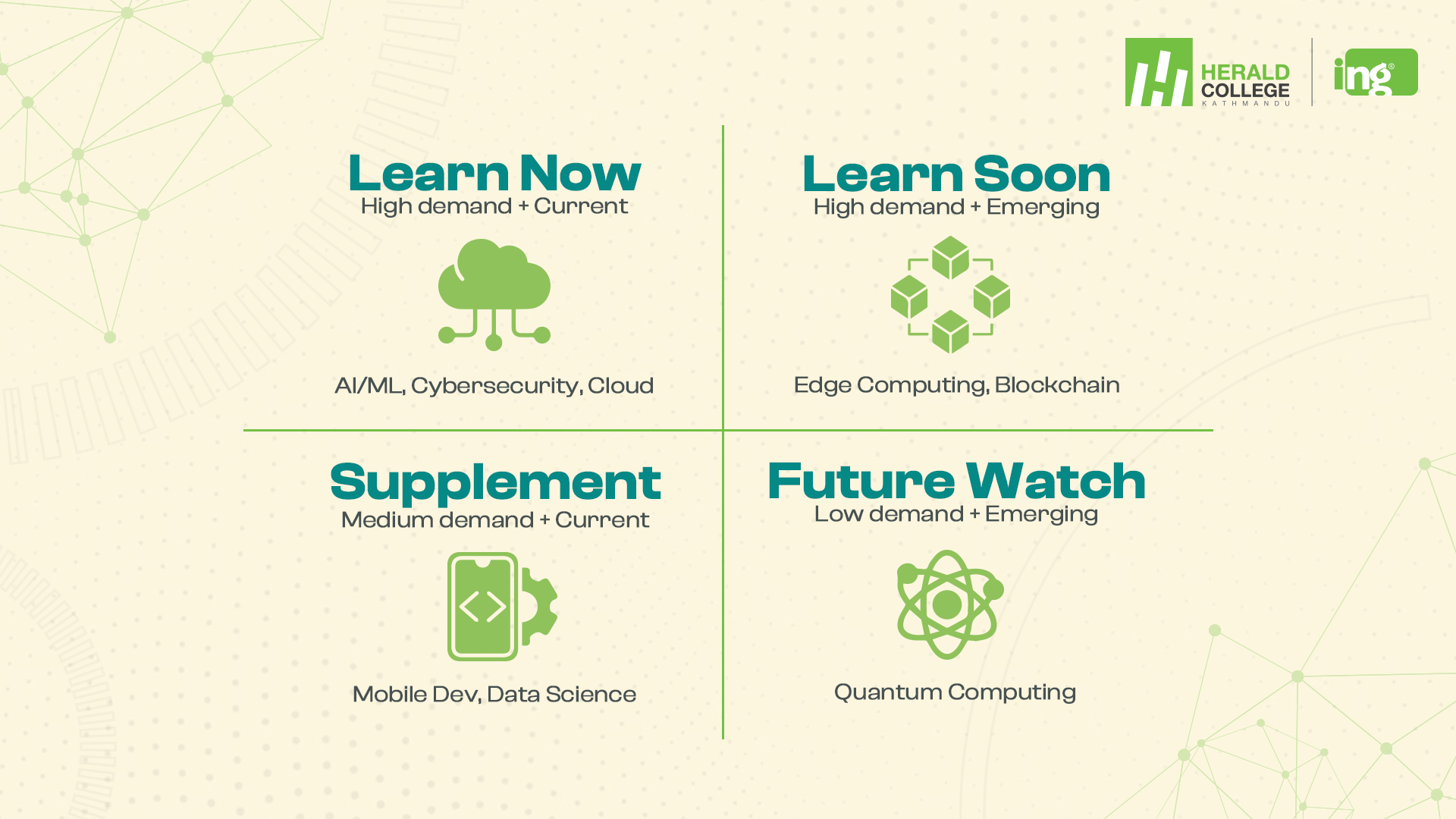
In order to future-proof their career path, IT students should be focused on following a strategic learning path that involves learning core fundamentals, specializing in new/emerging technologies, and learning continuously. The blend of college courses, online resources, and real-world projects keeps students prepared for the fast-changing IT industry in Nepal and around the world.
Quantum Computing: Towards the Next Generation of Computing
Quantum computing is a nascent technology that harnesses the principles of quantum mechanics to perform computations in ways that classical computers cannot. With applicability still confined within some boundaries for now in Nepal, the area of quantum computing potentially could revolutionize in the future, cryptography, optimization, and complex simulations.
Does it make sense for Nepali IT students to study Quantum computing?
Quantum computing is tailored towards research students or those interested in the more advanced areas of computing. It is less important for the average day-to-day IT job, but a little can never hurt, and students may draw inspiration, potentially spurring them to take on specialized fields and giving them a glimpse of the bleeding edge of technology.
Top Picks of the best UK IT Courses in Nepal
Established UK quality degree programmes in Nepal are now offering advanced topics on computing, such as basic concepts of quantum computing. These programmes enable inquisitive students to gain the knowledge and skills they need to continue their investigations or pursue graduate studies abroad, allowing them to advance in state-of-the-art technology.
Why Herald College Is a Good Choice for IT Students
Herald College IT is one of the best IT colleges in Nepal with an updated syllabus that includes cloud computing, artificial intelligence, cybersecurity, data analytics, etc. The college has good labs and infrastructure, which help students to get practical exposure with theoretical classes. Students at Herald College also get international exposure in the form of Workshops, Training Programmes, and Collaborative Events. These experiences allow them to have strong portfolios and be more attractive to potential employers.
The college strongly focuses on production projects that students can directly apply to their future in technology. Its broad range of connections with industry and other organisations means that it also helps you with finding internships and jobs, and that your graduate will be ready to find a career in an ever changing fast paced tech-driven world.
Conclusion
The fast pace of advancement in technology is part of what makes it so thrilling. AI jobs were almost unheard of in Nepal five years back; today, they belong to one of the most sought-after job types. A degree in IT is a great starting point, but lifelong learning and hands-on application are key. Side projects, internships, online courses, and certification programs, they all help you build skills and expertise.
There’s no need to know all the trends right now. A lot of people start out doing web development, then find they really like data science or information security. That’s to be expected in an evolving IT profession. The technology industry in Nepal is in its nascent stage and is ripe for young professionals to establish themselves as the torch bearers of the next decade.
Stay curious. Keep building. Keep going.

At Herald College Kathmandu, they're not just words on a wall—they're your roadmap to a global tech career. With UK degrees, real-world projects, and international opportunities, Herald transforms this quote into your future.